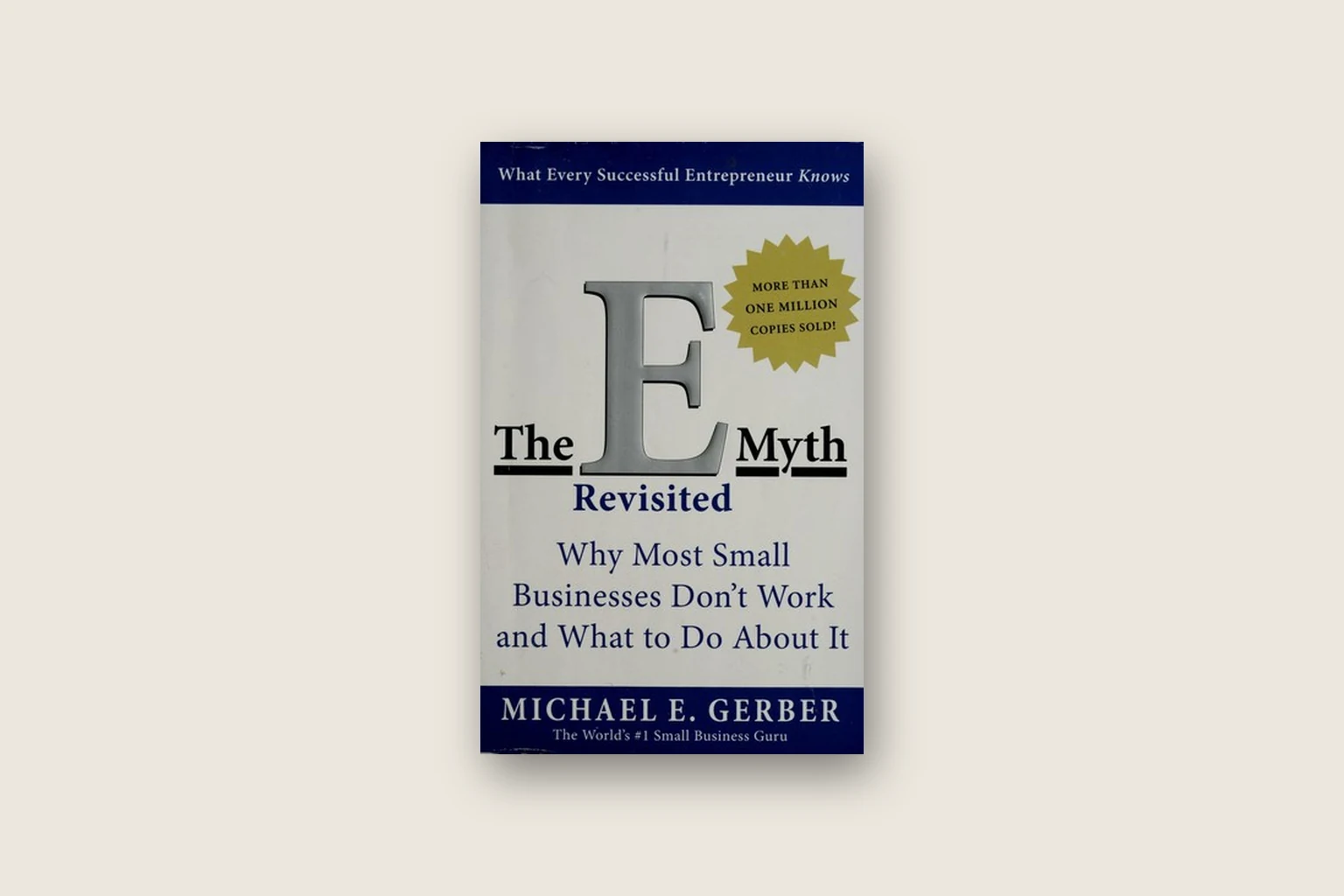
I finished The E-Myth Revisited. This is the whole book on one page, the summary I wish I’d had on page one.
The one idea
Most businesses are started by a technician having a bad day. A baker gets tired of working for someone and opens her own bakery. She assumes that if she understands the baking she understands a business that bakes. She doesn’t. Those are two different jobs, and the second one decides whether the place lives.
Gerber calls the moment she decides this the entrepreneurial seizure. What she really does is fire her boss and hire a worse one: herself. Now she bakes, cleans, orders, does the books and serves the customers. The craft she loved becomes the thing that traps her. She is good at it, so she keeps doing it. Because she keeps doing it, the business depends on her. Because it depends on her, it can’t grow past her hours.
The fix is one change of question. The technician asks “what work has to be done?” The entrepreneur asks “how must the business work?” The business is the product, not the pie.
Three people in one owner
Every owner is three people:
- The Entrepreneur lives in the future. Sees opportunity everywhere. Starts things. Gets bored. Changes the plan.
- The Manager lives in the past. Wants order, predictability and systems.
- The Technician lives in the present. Wants to do the work, and finish it, now.
The typical owner is about 10% Entrepreneur, 20% Manager and 70% Technician. The technician wins every argument because his work is the most concrete. A day of doing feels like progress. A day of designing how the doing should happen feels like nothing happened.
I find this the most useful part of the book, because it points at your hours instead of your org chart. Where your week actually goes tells you who is running the company.
Three ages of a business
Infancy: the owner and the business are one thing. Remove the owner and it disappears. Gerber’s test: if you left for three months, would it be better, worse, or dead when you came back?
Adolescence: the first hire. The owner makes the defining mistake: abdication instead of delegation. He hands over the work with no system, no standard and no way to check, calls it trust, watches it go wrong, takes it back, and is now more sure than before that he is indispensable.
Then the business reaches the edge of his comfort zone, the size where he still feels in control. He can go small again, go for broke, or grind at exactly that size forever. None of these changes what the owner is doing.
Maturity: the companies that got there did not grow into it. They started with a picture of the finished company and acted as that company from day one. Gerber’s example is IBM and its founder’s clear picture of what it would look like when done.
Build it as if you would sell 5,000 copies
Ray Kroc noticed one tiny restaurant ordering far more milkshake mixers than anyone. He went to look. He found a system that gave the same result every time, run by teenagers. The system was the product, and he bought it.
Gerber’s instruction: build your business as the prototype of a franchise, even if you will only ever own one. Six rules for it:
- Give customers, staff, suppliers and lenders more than they expect, every time.
- Design it so people with the lowest possible skill can run it. The system carries the intelligence.
- Make it a place of visible order.
- Write all of it down in operations manuals.
- Make the service predictable.
- Look the same everywhere: colours, tone, how a message reads.
And the slogan: work on your business, not in it. Working in it gives immediate proof, because the order gets packed. Working on it gives proof three weeks later, when someone else has packed 200 orders right without you. The technician always prefers the first kind of proof. Repeated daily, that preference is how a person builds a job instead of a company.
The seven steps
Part Three is a program, each step built on the last:
- Primary aim: what you want your life to be. This is the yardstick, and it comes before the business.
- Strategic objective: what the business must do for that life, in measurable standards, including whether it can make the money at all.
- Organisational strategy: the org chart of the finished business, a contract for each position, and then your own name written in every box you currently fill.
- Management strategy: a system that produces the result, instead of a person supervising.
- People strategy: the “game” worth playing, so people follow the system for a reason.
- Marketing strategy: what the customer wants to feel, and every signal in the business matching it.
- Systems strategy: hard systems (things), soft systems (scripts and steps) and information systems (the numbers).
Underneath all of them is a loop: innovate, measure, then lock it in.
Where it holds and where it cracks
It holds: the three roles, “the business is the product”, positions before people, and the difference between delegation and abdication. Most “I tried hiring and it failed” stories are abdication stories.
It cracks in three places:
- The evidence is anecdote and old franchise statistics. It is a strong argument, not a proven one.
- Rule 2 does not transfer cleanly to knowledge work. A burger can be made to spec by a teenager. A strategy memo or a hard sales call can’t be reduced to a checklist. Systems set a floor on quality, not a ceiling. Better rule: build it so an ordinary trained person gets a good result and a great person gets a great one.
- It underrates the technician. If your business sells expertise, the craft is the moat. Protect the technician’s time for the one craft that matters, and systemise everything around it.
What I’m taking from it
Two exercises, because they cost almost nothing:
- Draw the org chart of the finished business, then put my own name in every box I currently fill. The chart becomes a picture of how many jobs I’m doing.
- Ask of every recurring task: how would this get done if I couldn’t do it myself?