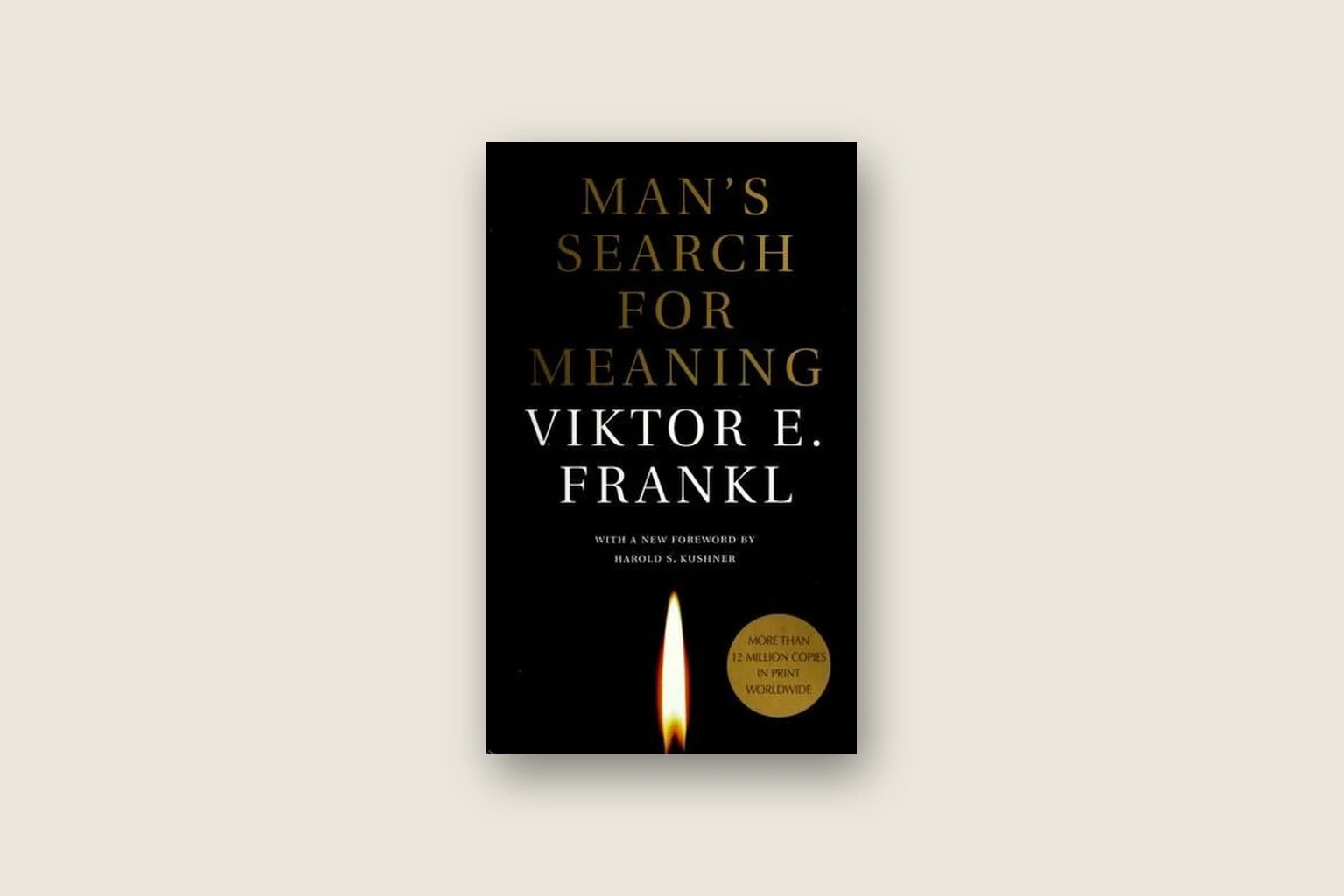
I didn’t find Viktor Frankl in his own book. I found him in The 7 Habits of Highly Effective People, in a few pages that stayed with me longer than the rest of the book. Later I read his Man’s Search for Meaning, and the idea only got bigger.
The one thing he still controlled
Frankl was a psychiatrist who spent three years in Nazi camps. Everything was taken from him: his name, his clothes, his family, the manuscript he had sewn into his coat. He controlled almost nothing about his days. Who lived and who died on the ramp was not up to him.
What he kept was his inner life: his thoughts and his imagination. In the camp he would picture himself standing in a bright, warm lecture hall, giving a talk about what he was living through. He spoke to his wife in his head. No guard could reach that. He writes that everything can be taken from a man except the last of the human freedoms: to choose your attitude in any circumstance.
That is what amazed me. Not that he stayed positive. That he held the one thing he still had, with full attention, and it carried him.
The circle gets bigger
Covey takes this and gives you a picture. Draw a circle around what you worry about, and a smaller one inside it around what you can actually influence. People who spend their energy on the outer circle get smaller. People who work on the inner one find it growing.
Frankl is the extreme case. His circle was reduced to almost nothing, just his own mind, and he worked on that. And look how large it became: through a book that has sold in the millions, a school of therapy, and a life that kept going after the camps.
That is the part I can’t stop thinking about. If you build the circle of what you control, no one can take it away from you. Not circumstances, not other people. And once you really see that, you become hard to stop. Not because things get easier. Because nothing outside can reach the part that decides what you do next.
What mindset does to survival
Frankl noticed something else, and it is the part that scared me a little. The men who gave up their reason to live died soon after. Between Christmas 1944 and New Year there was a spike in deaths in the camp, with no change in food, no new epidemic. He explained it this way: many prisoners had been telling themselves they’d be home by Christmas. When the day passed, something in them went out.
He tells of a fellow prisoner, a composer, who dreamed that the war would end for him on 30 March. He held on until 29 March, when the news turned bad. He fell ill that day. On the 30th he lost consciousness. On the 31st he was dead.
There is a similar pattern outside the camps. People who die soon after a loved one dies, researchers have a name for it, the widowhood effect. Something in a person lets go.
All of this tells me one thing: our mindset is part of our survival. Not all of it. But a real part.
So dream big?
If a reason to live keeps a man alive, then an anchor in something big should help us arrive at it. If we dream big, we have a bigger chance of reaching the dream. This sounds like The Secret and the idea of manifesting, and I think it is pointing at something real.
But I want to be careful here, because Frankl himself is careful, and the example above cuts against the easy version.
First, the composer did not die because he dreamed. He died because he anchored on a date. A reason with a deadline on it expires. Frankl’s own anchor was a task, rebuilding the manuscript he had lost, and a task does not expire at a particular hour. So when I say anchor on something big, I mean a direction you can work toward every day, not a day on the calendar.
Second, the mechanism is not that the universe delivers what you picture. It is that a big anchor changes what you do. You endure more, try again, and keep walking when the evidence says stop. That raises your chances. It does not guarantee them. Frankl was honest about it: the best of us did not return. A lot of who lived was decided by things no attitude touches.
So: dream big, yes. Because it keeps you moving, and it keeps you alive in the sense that matters. Just anchor on the work, not the date, and do the work.
Where it showed up for me
This idea changed how I train. I started going crazy more often and lifting heavier than felt comfortable, because if I go all in I will most likely achieve more than if I play it safe. Not every lift will go up. But the version of me that stays small never finds the limit.
There is a saying I can’t place: don’t bite off more than you can chew. I prefer the reverse. Bite big, and learn to chew big.
The weights taught me where that stops working. Biting big means the goal and the effort. The bar still goes up in steps, and a rep with broken form is not courage, it is an injury waiting. Big ambition, small increments, and no day that costs me the next hundred.
What I take from it
Every morning I ask myself what is inside my circle today, and I spend the day there.