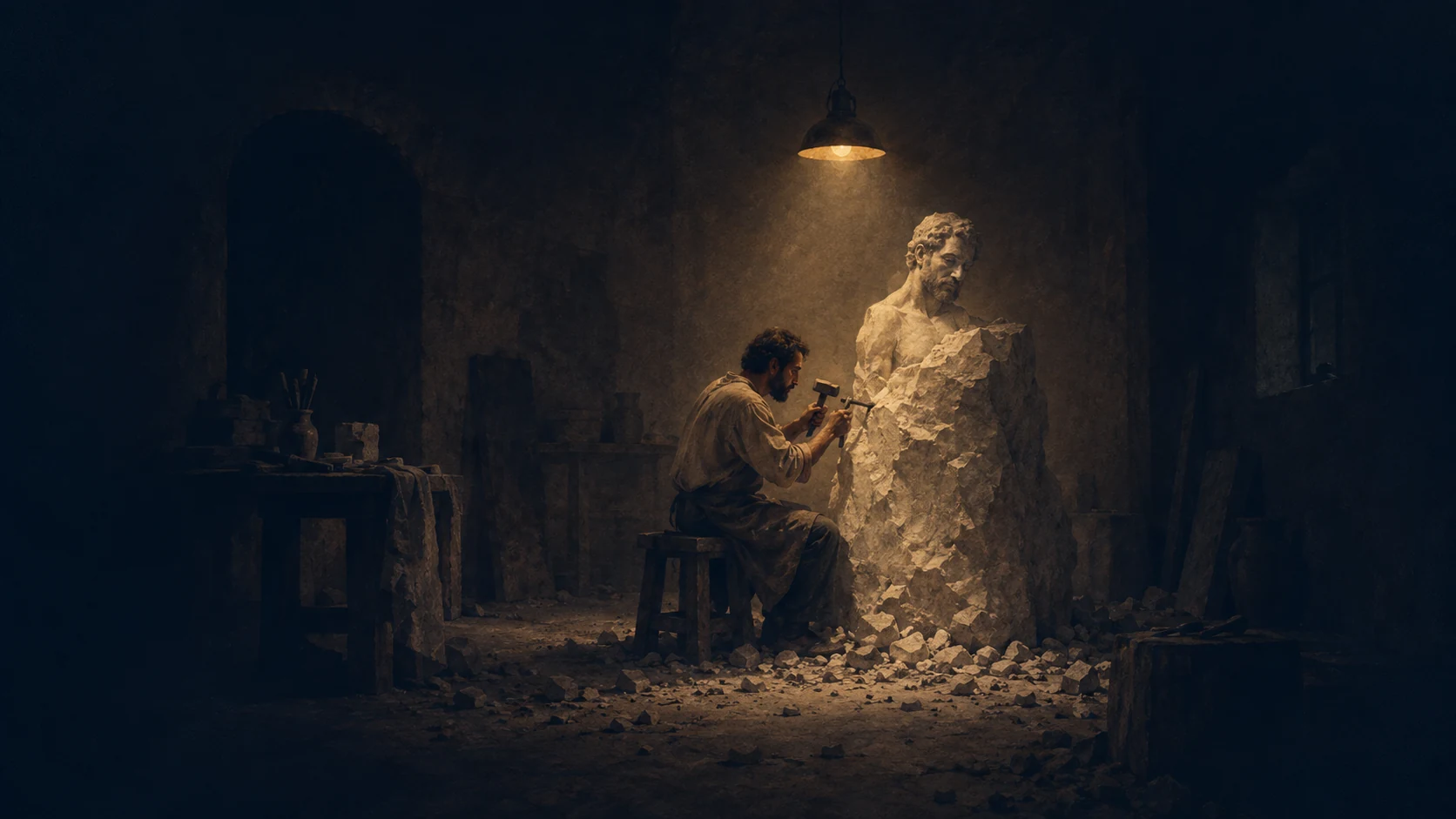
Surat al-Shams opens with the longest run of oaths in the Qur’an. By the sun and its morning light. By the moon. By the day, by the night. By the sky and the One who built it. By the earth and the One who spread it. By the soul, and the One who proportioned it, and inspired it with its wickedness and its piety.
Eleven oaths. And after all of that, the answer:
Qad aflaha man zakkāhā. He has succeeded, the one who purifies it — and failed, the one who buries it.
God swears eleven times in a row to tell you one thing. The project is you. Not the company, not the body, not the reputation. Success, as far as that verse is concerned, is one verb, and the object of the verb is your own self.
That verb is tazkiya. It means two things at once: to lift the self out of sin, and to clean it of its flaws. No sins, no faults — that is the job. And it has no finish line. You are asked to do it every day, and it ends when your foot is inside Paradise. Not before.
The door is a low opinion of yourself
The scholars of the path — the ones who spent their lives on how the self actually behaves — agree on where tazkiya starts. The first door is that a person thinks badly of himself, and well of his Lord and of other people.
It sounds harsh until you watch what the opposite does. The man who thinks well of himself stops. He becomes proud, then pleased with himself, then settles into a lazy contentment — I’m a good person, I’m fine. He stops accepting advice, because advice is for people with problems. Long hope fools him. He feels safe.
The best human being after the prophets is Abu Bakr. When the Prophet ﷺ asked his companions one morning who among them was fasting that day, Abu Bakr said I am. Who had followed a funeral? I have. Who had fed a poor man? I have. Who had visited someone sick? I have. And when this same Abu Bakr asked the Prophet ﷺ to teach him a supplication, he was taught to say: O God, I have wronged myself greatly.
Greatly. That is the line given to Abu Bakr. I have no idea what line that leaves for me.
Al-Hasan al-Basri once heard people talking at length about humility and cut them short: humility is that you don’t meet anyone without thinking he is better than you. The old saying makes it practical. If you see someone older than you, say: he reached good deeds before me. If you see someone younger, say: I reached sins before him. Either way, he’s ahead.
This is not self-hatred, and the difference matters. A low opinion of the self that pushes you to fix it is tazkiya. A low opinion that paints such an ugly picture that you give up is its own disease — despair, and it ends in the same place pride does: you stop working.
Two halves of one sentence
Ibn Taymiyya said something about the fourth verse of al-Fatiha that I cannot stop thinking about. Iyyāka naʿbudu — You alone we worship — drives out showing off, because I’m doing this for You, not for them. Wa iyyāka nastaʿīn — and You alone we ask for help — drives out pride, because I can’t do it without You.
You say both halves at least seventeen times a day. Look at how worship itself is built. The call comes — come to prayer — and the answer taught to you is there is no power and no strength except through God. Before the act, you admit you can’t. Then you pray. And when you finish, the first thing you say is astaghfirullah — I seek forgiveness, for everything I did badly inside the thing I just did well. The prayer is bracketed by humility on both sides.
I keep my whole life in one system — what I prayed, how I slept, what I shipped. Iyyāka nastaʿīn is the line that keeps the system from becoming the thing I trust.
Who purifies a person
Four things.
God. Rather, God purifies whom He wills. It is His before it is yours.
The Prophet ﷺ. He sent among the unlettered a messenger from themselves, reciting His verses to them and purifying them. The more you know him, the more often you can stop in a hard moment and ask what he would do in your place — and actually find an answer. The person who doesn’t know him has nothing to ask.
You. He has succeeded, the one who purifies it. Nobody can do this part for you.
People. They purify you too — they draw your edges and name what you can’t see. That one needs its own essay.
Trained, not born
Left to its nature, the self is ruined. The Qur’an describes that nature without flattery: impatient, anxious when harm touches it, stingy when good does, unjust, ignorant. The speaker I heard this from put it in one line I have kept: the people of Paradise are people of trained nature, not people of nature. Nobody is born fit for it. People get there by training what they were born with.
Training has stages. There are four, and each one fails in a specific way.
1 · Know. You cannot change what you cannot see. You will keep making the same mistake until someone points at it — and the hard truth is you don’t know yourself nearly as well as you think.
2 · Admit. The enemy of change is justification. You’re short-tempered. — You people provoke me. Justification is a preservative: it doesn’t improve the taste of anything, it just keeps the thing exactly as it is for years.
There’s a subtler failure here: admitting, then stopping. Yes, I’m short-tempered, that’s how I am, that’s how God made me, my father was the same — so deal with it. That isn’t an admission. It’s the victim’s role, rewritten. And the answer is one verse: To Him belong the creation and the command. The One who created you quick to anger commanded you not to be angry. You don’t get to take the first half and leave the second.
3 · Decide. A plan, not a mood. What will you do tomorrow, specifically?
4 · Repeat. Once is not enough. Twice is not enough. Forbearance comes by practising forbearance. Whoever tries to be patient, God makes him patient. A man keeps telling the truth and seeking it until he is written with God as truthful. Written — as in, it becomes what he is.
Think of driving. At first you watch every movement: the mirror, the pedal, the gear. That’s the stage of building the automatic. Later you drive and don’t notice you’re driving. Now you are not a person who drives — you are a driver. That is the whole difference between doing a thing and becoming it, and there is no route to it except repetition. It is the same argument I made in The Day Is the Unit: every day is a vote for who you are.
The body tires, the self rests
One last thing, because it explains why any of this is worth the pain. The self runs opposite to the body. The more the body tires, the more the self rests.
Look at the day you spent in real effort: you fall asleep the moment your head is down. Now look at the day you gave the body everything it asked for — slept in, made excuses, skipped what you owed. The body rested. Something inside you didn’t. Your view of yourself shook a little. You feel a tightness you can’t name.
An old Arab poet said it better than I can:
I slept on ostrich feathers and found no bed as soft as having done my duty.
Tazkiya is not a mood you wait for. It is a craft, done daily, against your own grain, and the only one of your projects that is guaranteed to matter.
This is the first of three pieces on the self. Next: You Don’t Know Yourself, then The Mirror. The ideas started with an episode of the Arabic series Boosla — “Why is it hard to change yourself?”.