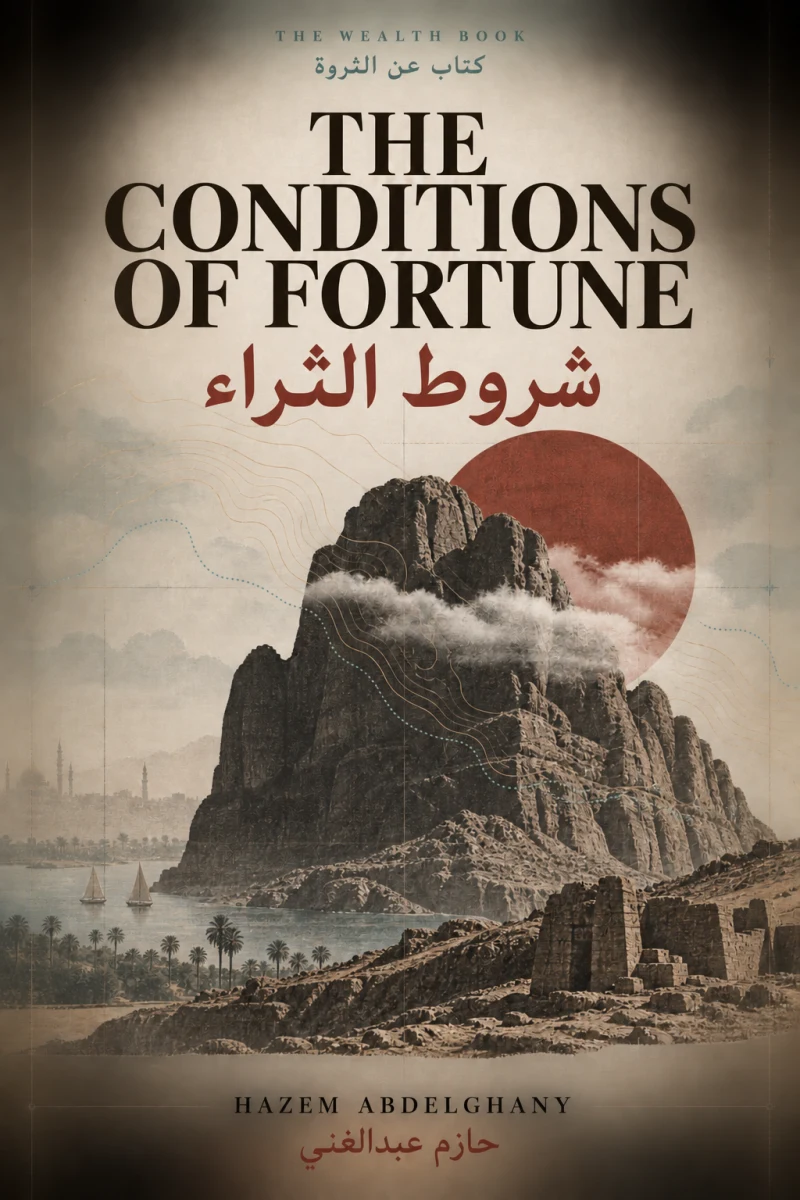
The Conditions of Fortune
شروط الثراء
What builds wealth, what luck supplies, and what survives the evidence
Ten fortunes taken apart to the mechanism. Five frameworks tested until they broke. And an honest line drawn between what every wealthy person had — and what was only the weather they happened to be standing in.
This book was not written by a rich person. That matters, and it cuts both ways.
It means there is no fortune here to sell you, no course at the end, and no incentive to make any particular road look easier than it is. It also means the authority in these pages is borrowed entirely from the public record — annual reports, court filings, proxy statements, tax leaks, and the places where people’s own stories stop matching their own numbers.
So read it as a survey, not a sermon.
Who this is for
Someone at or near the beginning. You may be earning well — that is not the same thing — but you do not yet own an asset that grows without you. You are capable, you are willing to work, and what you are missing is not effort but a map.
It is written with particular attention to readers outside the United States and Western Europe, where most of this literature is produced and almost all of it is set. If you are building in a country with a currency that loses value, capital controls, thin local credit and courts you cannot fully rely on, you are not a footnote to the story.
What it does differently
Books in this genre profile successful people and extract lessons. The problem is structural: when you study only winners, every trait they share looks like a cause. A book assembled that way will confidently tell you that all ten of these people were persistent — and never mention the ten thousand equally persistent people you have never heard of.
So this book separates its ten cases into two categories, and the separation is the whole argument. Bedrock is what was present in every single case, without exception — candidates for genuine laws, and there are fewer than you would expect. Weather is what was present in some and absent in others: inherited money, technical skill, investors, a degree, a product, an audience. Each is disproved as a requirement by at least one person on this list, which means each one is an excuse you are no longer allowed to use.
Every claimed invariant was put through a hostile review whose explicit instruction was to break it. Several broke. Those are reported as broken, with the exception named, because a false law is worse than no law at all.
The parts
- Part OneThe equationThree terms, multiplied. Miss any one and the answer is zero, no matter how large the others.
- Part Two · Engine 01Warren BuffettHe bought insurance companies to invest their customers' unpaid premiums as permanent leverage that cost him less than nothing, then never sold anything for sixty years.
- Part Two · Engine 02Jeff BezosRoughly 41% of a company he deliberately ran at near-zero profit for two decades, financed with customers' cash and suppliers' payment terms rather than his own.
- Part Two · Engine 03Bernard ArnaultOther people's capital and a state privatisation bought century-old names their owners could no longer value. He threw away everything except the name.
- Part Two · Engine 04Sam ZellHe bought over-levered American real estate from desperate lenders, paid almost entirely with debt, and sold the largest one weeks before the credit market shut.
- Part Two · Engine 05Naval RavikantBadly burned learning how venture financing actually works, he published that knowledge free for three years, and converted it into deal flow and a regulated platform.
- Part Two · Engine 06RihannaTwelve years of music built the one asset nobody could take. Then she stopped renting it out for fees and traded it for half the equity instead.
- Part Two · Engine 07Naguib SawirisPosition as the engine: a licence, an approval, a concession, the leverage Western wealth literature barely mentions and emerging markets run on.
- Part Two · Engine 08Jensen HuangCode, compounded across three decades, and a bet on a computing shape the market did not want yet.
- Part Two · Engine 09Alex HormoziHe inverted the advice: stopped owning gyms and started charging fees. Media as the engine, and the one case where equity was the wrong call.
- Part Two · Engine 10Sara BlakelyBrand from nothing, no investors, no inherited money, no technical skill, profitable in year one. The case that breaks the humiliation myth.
- Part ThreeBedrockEight things present in every single case, without exception, and the one that is deeply uncomfortable.
- Part FourWeatherInherited money, technical skill, investors, a degree, a product, an audience. Each is disproved as a requirement by at least one person on this list.
- Part FiveThe five mapsFive canonical frameworks, each put through the ten cases until it broke, and what survived of it.
- Part SixWhere the maps disagreeThe places the frameworks contradict each other, and which one the record backs.
- Part SevenThe ground you are standing onCurrency that loses value, capital controls, thin local credit, courts you cannot rely on. Which roads are actually open to you.
- Part EightDos and don'tsWhat the record supports, and what the genre repeats that nobody in this book actually did.
- Part NineFrom zeroIf you own nothing today, the order of operations, and the first move.
- CodaThe missing denominatorBase rates for every lane. How many tried, and how many you never heard of.